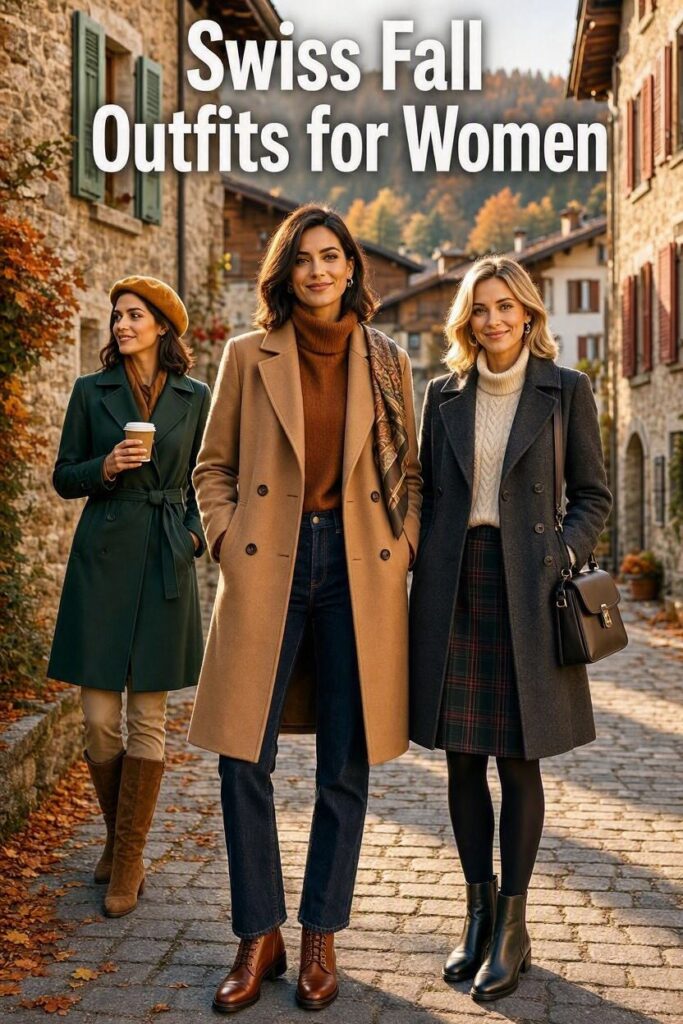
Swiss fall outfits for women need to do something that many fashion-editorial outfits do not: survive real life.
That means walking through cities, sitting on trains, carrying a bag, dealing with rain, moving between heated interiors and cool streets, and possibly heading into the mountains on the same trip.
The solution is not sacrificing style.
It is choosing pieces that work harder.
A good Swiss autumn wardrobe combines soft knitwear, structured outerwear, comfortable bottoms, supportive footwear and smart layers.
The Swiss Fall Outfit Formula for Women
Start with:
One comfortable bottom + one fitted or refined top + one warm layer + one weather layer + practical shoes
From there, change the proportions depending on the destination.
For city days, the outfit can be more polished.
For mountain trips, function becomes more important.
1. Dark Jeans and a Fine Knit
This is probably the easiest Swiss fall outfit.
Wear:
- Straight-leg dark jeans
- Fine merino sweater
- Wool coat
- Ankle boots
- Scarf
The silhouette is simple and easy to repeat.
Dark jeans also travel well because small marks are less obvious.
Styling adjustment
If the jeans are straight and the coat is oversized, choose a relatively fitted sweater.
If the jeans are wide-leg, a shorter jacket or neatly tucked sweater can help define the waist.
2. Wide-Leg Trousers and a Turtleneck
Try:
High-waisted wide-leg trousers + fitted turtleneck + cropped quilted jacket + boots
This is comfortable without looking sloppy.
The advanced trick is balancing volume.
Wide trousers already create a lot of fabric around the lower body. Adding an oversized long sweater can make the entire silhouette look heavy.
A fitted top creates contrast.
3. Midi Skirt and Boots
A midi skirt works particularly well in Swiss cities.
Wear:
Midi skirt + fine knit + tights + ankle boots + long coat
For colder days, swap the fine knit for a slightly heavier sweater.
The skirt fabric makes a difference.
A pleated synthetic skirt travels well because it resists wrinkles, while silk or satin can look luxurious but may require steaming.
That is worth considering if the itinerary includes several hotels.
4. Knit Dress and Long Coat
A knit dress is an easy one-piece outfit.
Add:
- Belt
- Tights
- Boots
- Long coat
- Scarf
A belt is useful when the dress is loose.
But do not force a belt onto every knit dress. Heavy knit fabric can bunch around the waist and create unnecessary bulk.
5. Dark Trousers and a Blouse
For a polished city day:
Tailored trousers + blouse + cardigan + ankle boots
A silk-look blouse creates a dressier appearance.
For travel, consider washable fabrics that imitate silk rather than delicate silk itself.
This is one of those situations where the more expensive fabric is not automatically the more practical choice.
6. Casual Denim and Quilted Jacket
For relaxed sightseeing:
Dark jeans + striped top + quilted jacket + sneakers
The quilted jacket is useful because it adds warmth without the visual weight of a thick wool coat.
It also packs more easily.
The downside is that some quilted jackets can look overly sporty.
Choose a clean, minimal design if the rest of the outfit is urban.
7. Camel Coat and Monochrome Base
Try:
Black trousers + black knit + camel coat + brown or black boots
This creates an elegant silhouette with almost no effort.
The secret is texture.
Combine:
- Matte trousers
- Ribbed knit
- Smooth coat
- Leather boots
Different surfaces prevent a neutral outfit from looking flat.
8. Cream Sweater and Brown Trousers
Autumn colors do not have to mean orange and mustard.
Try:
Cream knit + chocolate-brown trousers + dark brown boots + wool coat
This combination looks warm and seasonal without becoming costume-like.
Brown is also easier to coordinate than many brighter autumn shades.
9. Rainy-Day Swiss Outfit
For wet weather:
Merino sweater + straight trousers + waterproof shell + weather-resistant boots
Add a crossbody bag rather than a delicate shoulder bag.
The bag itself should ideally have a material that can tolerate light rain.
Leather can handle some exposure, but prolonged moisture can damage it if it is not properly treated.
10. Alpine-Inspired Women’s Outfit
For a mountain excursion:
Base layer + fleece or merino mid-layer + insulated vest + weatherproof shell + hiking trousers + hiking shoes
This is not the place for fashion-first footwear.
Mountain paths can be uneven, wet or slippery.
A stylish sneaker does not suddenly become a hiking shoe because it is worn in Switzerland.
11. Swiss Chalet Outfit
For a cozy evening:
Wide-leg trousers + oversized cardigan + fitted base + warm socks + ankle boots
Or:
Knit dress + thick tights + cardigan + boots
The oversized cardigan works best when the base layer is relatively slim.
Otherwise, the layers can become uncomfortable very quickly.
12. Leather Jacket and Knit
For mild autumn weather:
Straight jeans + fine knit + leather jacket + boots
Leather provides some wind protection but is not a substitute for an insulated coat.
It can also become uncomfortable indoors because leather does not breathe like many lighter woven fabrics.
Use it on moderate days.
13. Blazer and Sweater Combination
For a polished city look:
Tailored trousers + T-shirt + fine sweater + blazer + loafers
The blazer provides structure.
A soft sweater underneath prevents the outfit from looking overly corporate.
For colder weather, swap the blazer for a wool jacket.
14. Long Skirt and Short Jacket
This is a useful proportion trick.
Wear:
Long skirt + fitted sweater + cropped jacket + ankle boots
A shorter outer layer balances a longer skirt and helps keep the silhouette from becoming visually heavy.
15. Minimalist Swiss Capsule Outfit
For a five-day trip, build around:
- Dark jeans
- Tailored trousers
- Midi skirt
- Two fine sweaters
- One blouse
- One long-sleeve top
- One wool coat
- One weatherproof jacket
- Sneakers
- Boots
- Scarf
That is enough for a surprising number of combinations.
Three Advanced Styling Rules
Rule 1: Keep the warmest fabric closest to the body only when needed
People often assume the thickest sweater should be worn directly against the skin.
Not always.
A fine moisture-managing base layer underneath a slightly looser wool sweater can be more comfortable because it prevents itchiness and improves temperature control.
Rule 2: Watch friction points
Backpacks and crossbody bags repeatedly rub against knitwear.
Cashmere and very soft wool can pill or develop surface wear in those areas.
For walking-heavy days, use a tougher merino or wool blend.
Save delicate cashmere for low-friction days.
Rule 3: Do not underestimate sock thickness
A thick sock inside a narrow boot can make the entire footwear system less comfortable.
Instead, start with a roomier boot and choose a sock appropriate to the actual temperature.
Swiss Fall Outfit Mistakes to Avoid
Avoid:
- Wearing a giant sweater under a narrow coat
- Taking only fashion shoes
- Packing delicate fabrics for every day
- Wearing suede in consistently wet weather
- Choosing trousers that drag on the ground
- Treating city clothing as mountain clothing
- Packing outfits that only work in one combination
Quick Outfit Decision Framework
Before getting dressed, ask:
Where is the day happening?
City = polished and comfortable.
Mountain = functional and weather-ready.
Restaurant = upgrade one element.
Rain = prioritize outerwear and footwear.
Long travel day = prioritize stretch, layers and shoes.
Cold morning = add insulation.
Warm afternoon = remove the middle layer.
That is the whole system.
Next step: choose five core pieces from the wardrobe, then create at least three Swiss fall outfits around each one. Keep the combinations that work for both comfort and movement, and leave the single-use pieces at home.