Double denim has a reputation problem.
Mention a denim jacket with jeans and some people immediately picture stiff matching blue, oversized silhouettes, chunky belts and a very early-2000s approach to dressing. But denim-on-denim itself isn’t the problem. The problem is usually how the two pieces are combined.
Done well, double denim can look relaxed, modern and surprisingly polished. It can also work beautifully with Western-inspired outfits without turning the whole look into a costume.
The trick is to stop thinking about double denim as “matching denim” and start thinking about contrast, proportion, texture and balance.
A faded denim jacket with dark straight-leg jeans feels completely different from a matching denim shirt and jeans in the same wash. A cropped jacket changes the silhouette again. Add boots, a belt and a simple tee, and suddenly the outfit has a clear direction rather than looking like a denim uniform.
Here’s how to make the combination work in real life.
What Exactly Is Double Denim?
Double denim simply means wearing two denim garments in the same outfit, most commonly a denim jacket or shirt with jeans.
The easiest formula is:
Denim jacket + jeans + non-denim top + appropriate footwear
But there are plenty of other combinations:
- Denim shirt + wide-leg jeans
- Denim jacket + black jeans
- Denim overshirt + straight-leg jeans
- Denim vest + jeans
- Denim jacket + denim skirt
- Denim shirt + denim shorts
The goal isn’t necessarily to make the denim pieces match.
In fact, they often look better when they don’t.
Different washes, weights and textures create separation between the garments. That gives the outfit some visual breathing room.
The Biggest Rule: Don’t Match Everything
This is probably the easiest way to make double denim look dated.
A denim jacket and jeans in almost exactly the same shade can create a single uninterrupted block of fabric. That’s not automatically bad, but it can be difficult to pull off because the outfit has very little contrast.
Instead, try using different levels of darkness.
Dark jacket + lighter jeans
This creates a noticeable break between the top and bottom half.
For example:
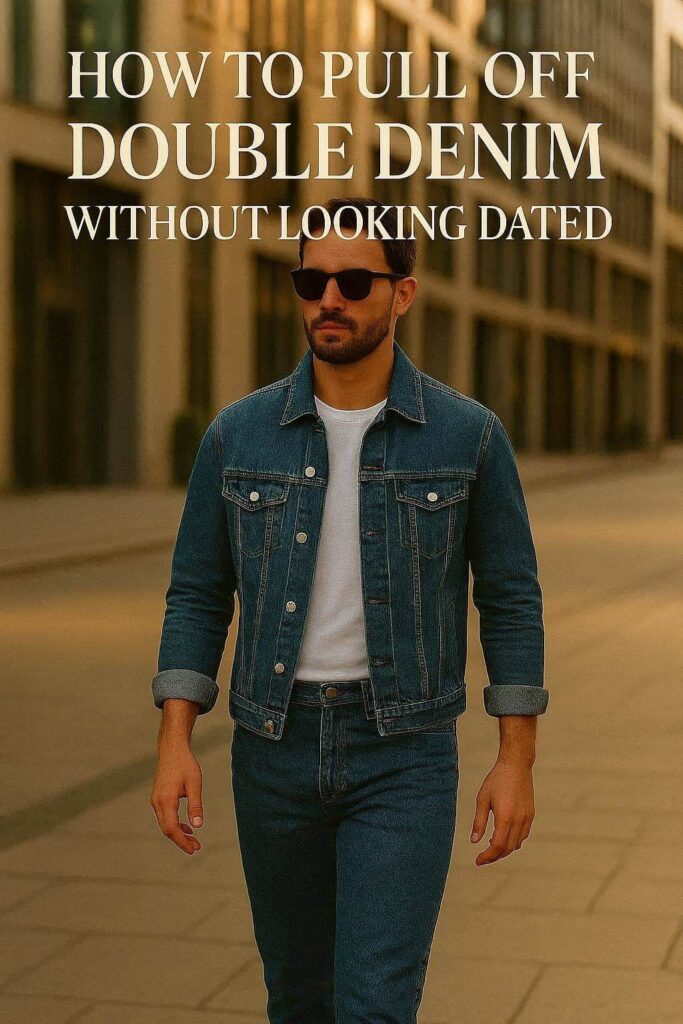
- Dark indigo denim jacket
- White or cream T-shirt
- Medium-wash straight-leg jeans
- Brown leather boots
The dark jacket gives the upper half some structure while the lighter jeans keep the outfit relaxed.
Light jacket + dark jeans
This tends to feel equally easy.
Try:
- Light-wash denim jacket
- Black or charcoal tee
- Dark indigo jeans
- Black ankle boots
The darker bottom half creates a longer-looking visual line, while the lighter jacket draws attention upward.
Different washes of blue
This is where double denim gets particularly interesting.
A medium-blue jacket with deep indigo jeans is simple enough for everyday wear. A faded blue jacket with raw-looking dark denim feels a little sharper.
The important part is making the difference obvious enough to look intentional.
Can Double Denim Be the Same Colour?
Yes. But matching shades require more attention to fit and proportion.
A tonal denim outfit can actually look very modern when the garments have different shapes or textures.
For example:
Dark denim shirt + dark straight-leg jeans + cream boots
The colour stays consistent, but the cream footwear breaks up the darkness.
Another option:
Medium-wash cropped jacket + medium-wash high-rise wide-leg jeans + white fitted tank
Here, the silhouette creates the contrast.
So the real rule isn’t “never match denim.”
It’s don’t let matching denim be the only thing creating the outfit.
Choose the Right Denim Shapes
Wash gets plenty of attention, but silhouette matters just as much.
Two denim pieces can have completely different effects depending on their cut.
Cropped denim jacket + high-rise jeans
This is a particularly useful combination because the jacket ends around the waist or upper hip while the jeans establish the lower half of the silhouette.
The result is a clearly defined waistline.
Try:
- Cropped denim jacket
- Fitted tank or tucked tee
- High-rise straight-leg jeans
- Low-profile trainers or ankle boots
This works well if you like a defined waist but don’t want a body-hugging outfit.
Oversized denim jacket + slim or straight jeans
A roomy jacket can look great with a relatively streamlined bottom.
The contrast is intentional:
Volume above + cleaner line below.
The problem starts when both garments are extremely oversized without any structure underneath. The entire silhouette can become visually heavy.
A fitted or semi-fitted top underneath usually helps.
Fitted denim shirt + wide-leg jeans
This works in the opposite direction.
The shirt provides structure through the upper body while the wide-leg jeans create volume below.
A partial tuck or fully tucked shirt can help define the waist and stop the fabric from swallowing the shape.
Long denim overshirt + relaxed jeans
This is the trickiest combination.
A long shirt and wide jeans can work, but both pieces need some deliberate structure. Rolling the sleeves, opening the shirt over a fitted tee or adding a visible belt can create useful breaks.
Otherwise, it can look like too much fabric in one place.
How to Put Together a Modern Double-Denim Outfit
Here’s a simple seven-step method that takes the guesswork out of it.
Step 1: Pick the denim piece you want noticed
Start with either the jacket, shirt or jeans.
If the jeans have an unusual cut, dramatic wide leg or strong fading, let them lead.
If the jacket has a cropped shape, Western yoke, embroidery or interesting texture, make that the focal point instead.
Don’t give every piece equal visual importance.
Step 2: Create contrast
Contrast can come from:
- Wash
- Colour
- Fit
- Texture
- Garment length
You don’t need all five.
Even a light denim jacket with dark jeans is enough.
Step 3: Add a non-denim layer
This is an underrated trick.
A white tee, black tank, cream knit, striped shirt or simple button-down creates a visual pause between the denim pieces.
It makes the outfit feel less like a matching set.
Step 4: Check the rise
High-rise jeans usually work particularly well with cropped jackets or tucked shirts because the waistline becomes part of the outfit.
Mid-rise jeans offer a more relaxed look and can work nicely with longer denim layers.
Don’t choose the rise simply because it’s trendy. Think about where the jacket or shirt ends.
The two lines should make sense together.
Step 5: Sort out the footwear
Footwear changes the entire mood.
For casual dressing:
- White trainers
- Canvas shoes
- Loafers
- Simple flat sandals
For Western styling:
- Cowboy boots
- Western ankle boots
- Suede boots
For a sharper outfit:
- Leather ankle boots
- Sleek loafers
- Minimalist heeled boots
The hem matters here.
A wide-leg jean that almost covers a boot creates a very different line from a cropped straight-leg jean that exposes the ankle.
Step 6: Add one or two accessories
A leather belt, watch, simple jewellery, structured bag or Western-inspired hat can finish the outfit.
Don’t pile on every accessory at once.
Double denim already has plenty of texture.
Step 7: Remove one thing
This sounds almost too simple, but it works.
Look in the mirror and remove one accessory or statement piece.
If the outfit still works, you’ve probably found the right level of styling.
Double-Denim Outfit Formulas That Actually Work
Sometimes it helps to see the whole outfit rather than individual rules.
1. The Everyday Classic
Medium-wash denim jacket
White crew-neck T-shirt
Dark straight-leg jeans
Brown leather belt
Brown ankle boots
Why it works: the dark jeans anchor the outfit while the lighter jacket creates contrast.
This is an excellent starting point for anyone nervous about double denim.
For a more relaxed version, swap the boots for white trainers.
For a Western variation, use a tooled or textured leather belt and simple cowboy boots.
2. The Modern Western Look
Faded denim shirt
Black straight-leg jeans
Tan suede belt
Western boots
Small silver jewellery
This is much easier to wear than going full Western with denim, fringe, turquoise, cowboy hat and statement boots all at once.
The black jeans give the denim shirt some separation and stop the outfit from looking overly coordinated.
For a softer version, replace black jeans with charcoal or dark indigo.
3. The Tonal Denim Outfit
Dark denim shirt
Dark indigo jeans
Cream tank
Brown leather boots
This is proof that denim pieces don’t have to contrast dramatically.
The cream top creates the necessary break between the two dark pieces.
Keep the accessories simple. The tonal colour scheme is already doing most of the work.
4. The Relaxed Weekend Outfit
Oversized light-wash denim jacket
Fitted white tank
Straight-leg medium-wash jeans
Low-profile trainers
Canvas or leather tote
The fitted base layer keeps the oversized jacket from becoming too bulky.
This is a good outfit for errands, coffee, travel or casual weekends.
For warmer weather, roll the jacket sleeves and choose lighter-weight denim.
5. The Polished Version
Dark denim blazer or structured denim jacket
Black or dark indigo jeans
Silk-look camisole or fine knit top
Pointed ankle boots
Minimal jewellery
This version works because the denim has more structure and the underlayer feels refined.
It can work for casual dinners, social events and less formal workplaces, depending on the dress code.
6. The Wide-Leg Version
Cropped denim jacket
Fitted neutral top
High-rise wide-leg jeans
Heeled boots or sleek trainers
This combination is all about proportion.
The shorter jacket visually defines the waist while the wide jeans provide volume below.
If the jeans are very long, footwear with a little height can prevent the hem from dragging.
The Denim Wash Cheat Sheet
Different washes create different moods.
| Denim combination | Overall effect | Best for | Potential problem |
|---|---|---|---|
| Light + dark blue | High contrast | Everyday outfits | Can look disconnected if colours clash |
| Medium + dark blue | Balanced | Casual to smart-casual | May feel too ordinary without accessories |
| Light + light blue | Soft and relaxed | Spring and summer | Can look overly casual |
| Blue + black | Sharp and modern | Evening, city dressing | Strong contrast can feel severe |
| Blue + white denim | Fresh and bright | Warm weather | White denim needs more maintenance |
| All dark denim | Sleek and streamlined | Evening, cooler months | Can feel visually heavy |
There’s no universal “best” combination.
Think about the effect you want first.
Advanced Styling Tips Most People Miss
1. Use a visible waistband as a visual break
A belt can do more than hold your jeans up.
When a denim jacket and jeans are similar in colour, a visible leather belt creates a horizontal break at the waist.
That little interruption can keep the outfit from looking like one continuous column of blue.
It also works particularly well with high-rise jeans and tucked tops.
2. Denim weight matters
Not all denim behaves the same way.
A heavy rigid denim jacket can hold a boxy shape, while lightweight denim drapes more softly.
Pairing two very heavy denim pieces can make an outfit feel stiff, especially in warmer weather.
If the jacket is structured and substantial, a softer pair of jeans can balance it.
Likewise, a lightweight denim shirt works nicely with jeans that have more structure.
3. Don’t overlook the shoulder line
An oversized jacket isn’t automatically relaxed-looking.
If the shoulder seam drops too far and the sleeves are very wide, the jacket can overwhelm a smaller frame or make the whole outfit look shapeless.
A slightly dropped shoulder can look intentionally oversized. A jacket that’s simply too big tends to look accidental.
There’s a difference.
4. Hem placement changes the footwear
This one is easy to miss.
A cropped straight-leg jean puts attention on the ankle and footwear. A full-length wide-leg jean puts more emphasis on the shoe’s toe and sole.
So if the boots are a major part of the outfit, choose a hem that allows them to actually be seen.
For Western boots, a longer straight or bootcut jean can create a clean line over the shaft. With ankle boots, a cropped or ankle-length hem can show more of the footwear.
5. Use texture to stop tonal denim from looking flat
Two similar blue denim pieces can look dull if both have the same flat surface and weight.
A worn-in jacket, textured belt, suede boots or a soft knit underneath introduces contrast without needing another loud colour.
Texture can do the job that colour usually does.
What to Wear With Double Denim
The beauty of denim is that it works with plenty of non-denim fabrics.
Leather
Leather adds structure and a slightly sharper edge.
Try black leather boots with blue denim for a modern city look or brown leather accessories for something warmer.
Suede
Suede and denim are especially good together because the soft, brushed texture breaks up denim’s harder surface.
Tan suede boots with blue denim are an easy combination for Western-inspired outfits.
Knitwear
A cream, oatmeal or grey knit softens denim.
This is especially useful during colder months when two denim layers alone can feel a little stiff.
Cotton
A plain cotton tee is still one of the safest options.
White, black, cream and grey all work because they don’t compete with the denim.
Silk-look or satin fabrics
For evening dressing, a smooth camisole or blouse creates a useful contrast with rugged denim.
The outfit immediately feels more intentional.
How to Wear Double Denim Through the Seasons
Spring
Go lighter.
Try a lightweight denim jacket, white tee, straight-leg jeans and trainers.
Pastel tops, cream accessories and lighter denim washes can make the outfit feel fresh without requiring lots of colour.
Summer
Keep the denim breathable and avoid stacking heavy pieces.
A lightweight denim shirt with denim shorts can work, especially when the shirt is worn open over a tank.
Another option is a sleeveless denim vest with wide-leg jeans, but consider the heat before adding another substantial layer.
Autumn/Fall
This is probably the easiest season for double denim.
Add:
- Suede boots
- Lightweight knitwear
- Leather belts
- Wool hats
- Earth-tone accessories
A dark denim jacket over a cream knit with medium-wash jeans is simple and practical.
Winter
The issue isn’t style. It’s bulk.
Layering a thick denim jacket over a chunky sweater can become uncomfortable quickly.
Instead, use a denim shirt underneath a wool coat or wear a denim jacket beneath a larger outer layer if the construction allows enough room.
The denim can still be part of the outfit without becoming the entire outerwear system.
Double Denim for Different Body Proportions
There isn’t one “correct” way to wear the trend.
Different cuts simply create different visual effects.
Want more definition around the waist?
Try a cropped denim jacket with high-rise jeans.
The shorter jacket ends closer to the natural waist, making that area more noticeable.
Prefer more coverage?
A longer denim shirt or jacket with straight-leg jeans creates a relaxed, continuous line.
Leave the shirt open over a fitted top if you want some structure underneath.
Like a longer leg line?
High-rise jeans with a relatively short jacket can visually shift the waist upward.
A full-length jean with a shoe that has a little height can also create continuity from hip to foot.
Want to balance wider-leg jeans?
Keep the upper half relatively structured.
That doesn’t necessarily mean tight. A fitted tank under a cropped denim jacket or a tucked denim shirt can provide enough definition.
Prefer an oversized look?
Go oversized in one main area first.
A roomy jacket with straight or slightly relaxed jeans is easier to control than an oversized jacket paired with extremely wide jeans.
Common Double-Denim Mistakes
Wearing almost identical washes without a plan
Matching denim can work, but accidental matching often looks less intentional.
Try instead: Make the difference obvious or create contrast with the top and accessories.
Choosing two oversized pieces with no structure
A huge jacket plus huge jeans can swallow the silhouette.
Try instead: Keep one piece more streamlined or define the waist.
Adding too many Western details
Cowboy boots, a cowboy hat, oversized belt buckle, turquoise jewellery, fringe and denim can quickly become a costume rather than an everyday outfit.
Try instead: Pick one or two strong Western details.
Ignoring denim weight
Two heavy denim garments can be uncomfortable, particularly indoors or in warm weather.
Try instead: Mix weights. Pair a lighter denim shirt with more substantial jeans.
Wearing uncomfortable boots
A great outfit isn’t particularly useful if walking becomes miserable after 20 minutes.
Try instead: Match footwear to the actual activity. A country concert outfit needs different footwear considerations from a quick dinner.
Forgetting the back view
Denim jackets can have dropped shoulders, box pleats, yokes or oversized backs that change the silhouette from behind.
Try instead: Check the outfit from several angles before deciding it’s working.
Over-accessorising
Denim already has visual texture.
Try instead: Add one standout accessory and keep the rest quieter.
When Double Denim Doesn’t Work
Sometimes it genuinely isn’t the right choice.
Skip it when:
- Both denim pieces are extremely stiff and heavy.
- The proportions make movement uncomfortable.
- The washes clash rather than contrast.
- You’re wearing multiple oversized layers in hot weather.
- The outfit has too many competing statement pieces.
- You don’t actually feel comfortable in denim.
There’s no prize for forcing a trend.
If denim-on-denim feels too much, use one denim piece with a non-denim bottom instead. A denim shirt with black trousers can deliver much of the same relaxed attitude without the visual weight.
Casual, Elevated and Western Versions
The same basic idea can move between different style levels.
Casual
Light denim jacket + white tee + straight jeans + trainers
Easy, comfortable and suitable for everyday errands.
Elevated Casual
Dark denim shirt + cream knit + dark jeans + leather loafers + structured bag
The cleaner fabrics and footwear make the denim feel more polished.
Western-Inspired
Faded denim shirt + dark jeans + brown leather belt + Western boots
Keep the rest simple.
Evening
Dark denim jacket + satin-look camisole + black jeans + pointed boots + understated jewellery
The smooth top and sharper footwear stop the denim from feeling too casual.
Where to Spend and Where to Save
Double denim doesn’t require an expensive wardrobe.
In fact, denim is one area where second-hand shopping can be particularly useful because well-worn pieces often have attractive fading and softness.
If spending more, prioritise:
- Good construction
- Comfortable fit
- Durable denim
- Reliable stitching
- A versatile wash
- A cut you’ll wear repeatedly
Don’t spend extra simply because a label calls something “premium.”
A beautifully constructed denim jacket that works with half the wardrobe is more useful than an expensive trend piece that only works with one outfit.
Also pay attention to stretch.
A little elastane can improve comfort, but highly stretchy denim may change shape more easily with wear. If long-term structure matters, a more rigid or low-stretch fabric can be worth considering.
Double Denim: Quick Decision Guide
| If you want… | Try this | Why it works |
|---|---|---|
| An easy everyday look | Light jacket + dark jeans | Clear contrast |
| A sleek outfit | Dark denim + black jeans | Creates a streamlined effect |
| A Western feel | Denim shirt + dark jeans + boots | Strong but controlled styling |
| A relaxed silhouette | Oversized jacket + straight jeans | Volume stays balanced |
| A defined waist | Cropped jacket + high-rise jeans | Clear horizontal break |
| A fashion-led silhouette | Cropped jacket + wide-leg jeans | Strong proportion contrast |
| A soft summer look | Lightweight denim shirt + denim shorts | Less visual weight |
| A polished outfit | Structured denim + refined accessories | Mixes casual and sophisticated textures |
The 10-Second Double-Denim Check
Before leaving the house, run through this quick list:
1. Are the denim pieces clearly separated?
Different washes, proportions or textures can help.
2. Is there a non-denim layer?
A tee, knit or blouse often creates the necessary visual break.
3. Does the silhouette have structure?
If everything is oversized, add definition somewhere.
4. Can you actually move comfortably?
Sit down. Walk around. Raise your arms.
5. Do the hems work with the shoes?
Don’t hide great footwear under an awkward length.
6. Are the accessories helping?
If the outfit already feels busy, remove something.
7. Does the outfit suit the occasion?
Double denim can go from grocery run to dinner, but the supporting pieces need to change.
The Easiest Double-Denim Outfit to Try First
Don’t start with the most complicated version.
Pull out:
A medium- or light-wash denim jacket
A plain white or cream T-shirt
Dark straight-leg jeans
A brown or black leather belt
Ankle boots or clean trainers
Put the tee on first, then the jeans. Tuck or half-tuck the tee if the rise allows it. Add the jacket and leave it open.
Now check the proportions.
If the jacket is oversized, keep the jeans relatively clean through the leg. If the jeans are wide, consider a shorter jacket or a defined waist.
Then add just one accessory.
That’s it.
Once that formula feels comfortable, start experimenting with different washes, wide-leg jeans, denim shirts, Western boots, suede and accessories. The modern version of double denim isn’t about perfectly matching two pieces of blue. It’s about making the contrast look deliberate.