Walk into any western store and the eyes go wide. Rows upon rows of shirts, piles of jeans, walls of boots, and belts that could anchor a small ship. It’s overwhelming. It’s designed to be overwhelming. The industry wants buyers to think they need forty different shirts and a boot collection that requires its own room.
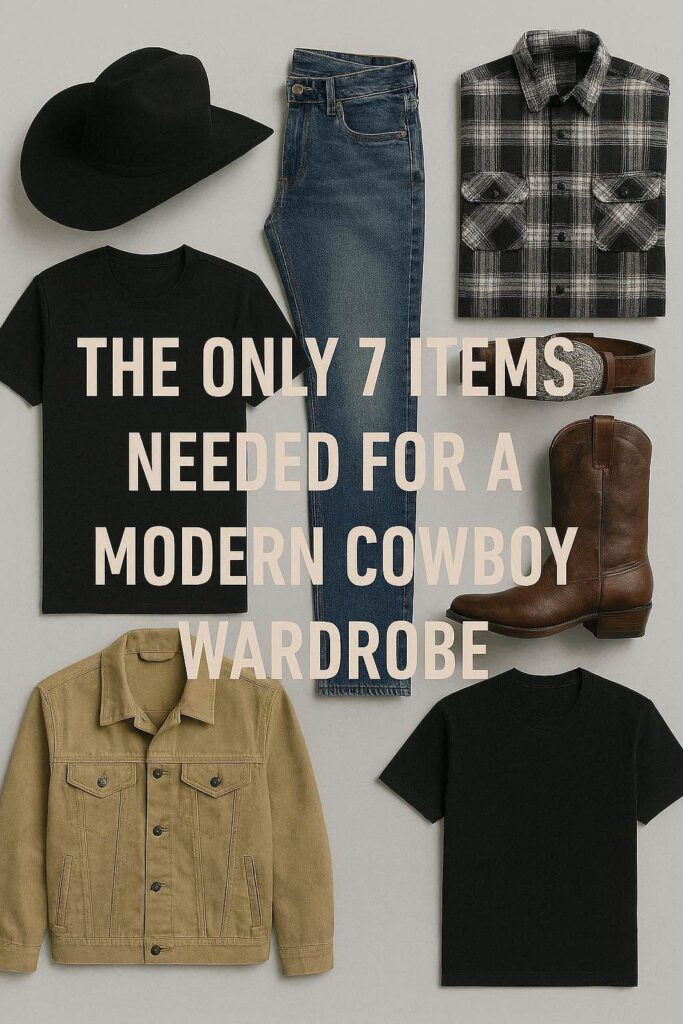
Here’s the truth: a modern cowboy wardrobe needs exactly seven items. Seven. That’s it. Everything else is just noise.
The secret isn’t having more. It’s having the right pieces that work together, that last, and that actually get worn. Not stuff that hangs in the closet collecting dust while the go-to favorites get beat up night after night.
Item 1: The Boots That Do Everything
One pair of boots. Not three. Not six. One.
The modern cowboy needs a boot that transitions from a Tuesday afternoon to a Saturday night without looking out of place. That means smooth leather, a moderate heel, and a round or square toe that doesn’t scream for attention.
The Specifics:
- Smooth cowhide or goat leather (not exotic)
- Walking heel with a slight angle
- Leather sole with a rubber heel cap
- Dark brown or black (pick one and commit)
The Honest Reality: These boots will take a beating. The leather will scuff. The soles will wear down. That’s the point. Well-worn boots look better than pristine ones every single time. Stop babying them. A quick buff with a damp rag and occasional conditioning keeps them alive without making them look like they’ve never left the closet.
The Insider Fact: Goat leather outperforms cowhide for daily wear. It’s lighter, more flexible, and resists water better. The grain is tighter, which means fewer deep scratches. Most guys overlook goat because they want the familiar look of cowhide, but once you try goat, everything else feels heavy and stiff.
Item 2: The Jeans That Fit Real Life
Forget everything about “true religion” or “fashion denim.” A cowboy needs jeans that allow movement. Real movement. Squatting, climbing, walking across uneven ground, sitting in a saddle or a truck for hours.
The Specifics:
- Slim straight or athletic straight
- 100% cotton or 98/2 cotton-elastane blend
- 13-15 ounce weight (heavy enough to hold shape, light enough to move)
- Dark wash with minimal distressing
- Proper rise that sits at the natural waist, not the hips
The Comfort Challenge: Heavy denim breathes poorly in summer. That’s a real problem. The solution isn’t thinner jeans—it’s knowing when to wear them. Keep lighter weight denim for summer and accept that the heavy stuff is for cooler months. Trying to make one pair work year-round leads to sweating through August or freezing through January.
The Insider Fact: Look for jeans with a higher back pocket placement. This lifts the backside visually and prevents that droopy diaper look that happens when pockets sit too low. Also, the inseam should have a slight curve at the knee, not a straight tube. Straight tube jeans bind when you sit. Curved inseams follow the natural leg position.
Item 3: The Shirt That Bridges Everything
One shirt. Just one. Make it count.
The Specifics:
- Plain or subtle pattern (small checks, tiny geometrics)
- Pearl snaps or standard buttons (snaps are more western, buttons more versatile)
- Western yoke (the curved shoulder seam) for structure
- 100% cotton oxford or twill weave
- No chest pockets or only one—two pockets gets busy
The Versatility Factor: This shirt works tucked or untucked. It works under a jacket or alone. It works with jeans or with trousers. That’s the test. If a shirt can’t do all of those things, it doesn’t deserve a spot in the seven-item wardrobe.
The Maintenance Reality: 100% cotton wrinkles. There’s no way around it. Steam it, iron it, or embrace the rumpled look. A perfectly pressed shirt looks stuffy anyway. The trick is intentional wrinkles versus messy ones. Shake it out, hang it in the bathroom while showering, and let the steam do the work. No need for a full ironing setup.
The Insider Fact: Twill weave resists wrinkles better than oxford. It has a diagonal rib pattern that hides creases and drapes more smoothly. Oxford is classic and breathable, but twill is the secret weapon for guys who don’t want to look like they slept in their shirt.
Item 4: The Jacket That Finishes the Look
Every wardrobe needs a layer. One jacket that works with everything else in the collection.
The Specifics:
- Denim trucker in dark wash, or waxed canvas in brown or olive
- Fits over the shirt with room for layering but not baggy
- Hits at the waist, not below the hip
- Minimal branding or patches
The Choice: Denim trucker is classic. It ages beautifully, it works with every shirt and jean combination, and it’s tough. Waxed canvas is the modern upgrade. It’s more refined, it’s water-resistant, and it develops a patina that denim can’t match. The downside is maintenance—waxed canvas needs rewaxing every year or two, and it’s heavier than denim.
The Honest Reality: This jacket will get worn in all conditions. Rain, wind, the occasional spilled drink. It will show every mark. That’s what makes it yours. A pristine jacket that never leaves the closet is worthless. A beaten-up jacket with stories is priceless.
The Insider Fact: When buying a trucker jacket, size down. They run big intentionally to allow for layering, but the modern fit should be trim. If you can fit a thick hoodie underneath, it’s too big. You should be able to wear it over just a shirt and have it look tailored. Buy it snug and let it stretch naturally.
Item 5: The Belt That Holds It All Together
Nothing kills a cowboy look faster than a flimsy belt. It’s the bridge between jeans and shirt, the anchor point that makes everything else work.
The Specifics:
- Full grain leather, 1.5 inches wide
- Removable buckle (silver, brass, or dark metal)
- Stitching matches the leather color
- Five holes (not three, not seven)
The Buckle Debate: Big rodeo buckles make a statement, but they also scream “look at me.” For a modern wardrobe, a medium-sized buckle with some detail—engraving, a slight curve, a brushed finish—works better. Save the massive buckles for special occasions.
The Wear Reality: This belt will crease. It will stretch where the buckle sits. It will show the curve of your waist. That’s normal. A belt that stays perfectly flat after years of wear is either made of plastic or never gets used.
The Insider Fact: The belt should match your boots in color but not in leather type. Smooth boots with a roughout belt creates contrast. Roughout boots with a smooth belt does the same. Matching everything exactly makes the outfit look like a costume. Contrast shows intentionality.
Item 6: The Hat That Identifies You
One hat. Pick it carefully, because this becomes your signature.
The Specifics:
- Wool felt or straw (seasonal choice)
- 4-inch brim
- Cattleman crease or brick crown
- Matching hat band (leather or simple ribbon)
- Fits snug but doesn’t leave a mark on your forehead
The Style Challenge: Black is dramatic but shows dust. Brown is versatile but more casual. Silver belly is the wild card—it’s light enough to work with dark and light clothing, and it doesn’t look as stark as black.
The Honest Reality: Hats get damaged. Rain ruins felt if you don’t treat it. Wind blows them off. They get knocked around in cars and bars. That’s the cost of wearing one. Accept that it will get beat up and buy something you don’t mind replacing every few years.
The Insider Fact: When buying a felt hat, steam the brim and shape it to your face. The standard store shape is generic. Put it on, look in a mirror, and physically bend the brim up or down until it frames your face properly. The front brim should curve slightly down, the sides slightly up. This takes five minutes and transforms the hat from “off the rack” to “custom.”
Item 7: The Accessory That Makes It Personal
This is the wildcard. One piece that reflects personality, taste, or history.
The Options:
- A silver bracelet or bolo tie
- A leather wallet with a branded design
- A vintage watch with a leather band
- A bandana in a complementary color
The Practical Reality: Accessories are personal. There’s no universal “right” choice. The only rule is that it should be something you actually wear, not a display piece. A bolo tie that lives in a drawer isn’t doing anyone any good.
The Insider Fact: If choosing a watch, go vintage. New watches with clean faces look out of place against denim and leather. A vintage piece with a slightly worn face and patina on the band feels like it belongs. Same for jewelry—tarnished silver reads as authentic. Shiny new metal reads as costume.
The Complete Seven-Item Wardrobe Comparison
| Item | Primary Choice | Secondary Choice | What to Avoid |
|---|---|---|---|
| Boots | Goat leather, walking heel | Smooth cowhide, roper heel | Patent leather, exotic patterns |
| Jeans | Slim straight, 14oz denim | Athletic straight, 15oz denim | Skinny fit, light wash, distressed holes |
| Shirt | Twill weave, one pocket | Oxford weave, plain front | Satin, synthetic blends, bold patterns |
| Jacket | Waxed canvas, waist length | Denim trucker, medium wash | Heavy leather, excessive patches |
| Belt | Full grain, 1.5″ width | Tooled leather, matching boots | Faux leather, skinny belts |
| Hat | Wool felt, 4″ brim | Straw, same crown shape | Crushable travel hats, oversized brims |
| Accessory | Vintage watch or bandana | Silver cuff or bolo | Any jewelry that matches perfectly |
The First Next Step
Stop shopping. Seriously. Just stop.
Take whatever money would go toward buying multiple items and put it toward the highest quality version of one item on this list. The boots, if they need upgrading. Or the jacket, if the current one doesn’t fit right. One piece at a time. The worst mistake in building a wardrobe is buying seven mediocre items that all need replacing in a year.
Audit the current collection. Which item on this list is the weakest link? Which piece gets the most comments, the most compliments, the most use? Which one sits in the closet untouched?
Replace the weakest link first. That’s the actual next step. Walk into a store with a budget, try on everything that fits the specific criteria from this list, and buy exactly one thing. Wear it for a month. Then do the audit again and replace the next weakest link.
Seven items. Seven months. Seven upgrades. That’s how you build a wardrobe that looks intentional, lasts for years, and actually gets worn.
Anything else is just stuff in a closet.